The 10 Essential Elements of a Learner-Driven Community
By Spencer Steinert, Head of School, Wonder KC
When families in Kansas City start researching Acton Academy, they run into something confusing fast: every campus looks a little different. One meets in a converted house. Another has a hundred learners. Some talk about Quests, others about apprenticeships.
That's by design. Acton isn't a franchise with a standard building and a standard curriculum. It's a network of independently owned schools, each started by parents who wanted something different for their own children. Wonder KC is one of them.
So what makes them all Acton? Ten elements. Acton co-founder Laura Sandefer wrote a series on her blog walking through each one, and they're the clearest answer to the question "what is this, actually?"
Here they are, and what each looks like at Wonder.
The paradox at the center
Before the list, there's a tension worth naming, because it explains why the elements work together rather than separately.
A learner-driven school is intensely individual. Every child moves at their own pace, sets their own goals, and chases their own interests. But it's also intensely communal. Learners write shared promises, hold each other accountable, and can't opt out of the group.
Those two things sound like opposites. They aren't. The freedom only works because of the community, and the community only holds because each person owns their part in it. Pull out either half and the model collapses. Most schools that try to copy Acton copy the freedom and skip the covenants, and it goes badly.
1. The Hero's Journey
Every learner is treated as the hero of their own story, not a passenger in someone else's. The framing comes from Joseph Campbell: a call to adventure, a road of trials, allies and mentors, a return with something to give. Children understand this instinctively because it's the shape of every story they love.
It isn't decoration. When a learner is struggling, a guide can ask where they are in their journey, and the child usually knows.
2. Growth Mindset
Ability isn't fixed. Effort and strategy change what you're capable of. At Wonder, that shows up in how we talk: we praise the work and the persistence rather than the talent, and we treat "I can't do this" as a sentence that's missing the word yet.
3. The Studio Contract
At the start of each year, learners write the rules of their own studio and sign them. Not a list handed down by adults. Their list, debated line by line, adopted only when everyone agrees. It can take several weeks.
That slowness is the point. A rule you argued over and chose is a rule you'll actually defend.
4. Mixed-Age Studios
Learners of different ages share a studio. Older learners teach, which is the fastest way to deepen your own understanding. Younger learners see what's possible a year or two ahead. Nobody is boxed into what a "fourth grader" is supposed to know.
5. The Socratic Method
Guides ask instead of tell. Every day begins with a launch: a question, a story, or a dilemma with no clean answer. Learners argue, change their minds, and discover that reasoning is a skill you can practice.
6. Trial and Error Learning
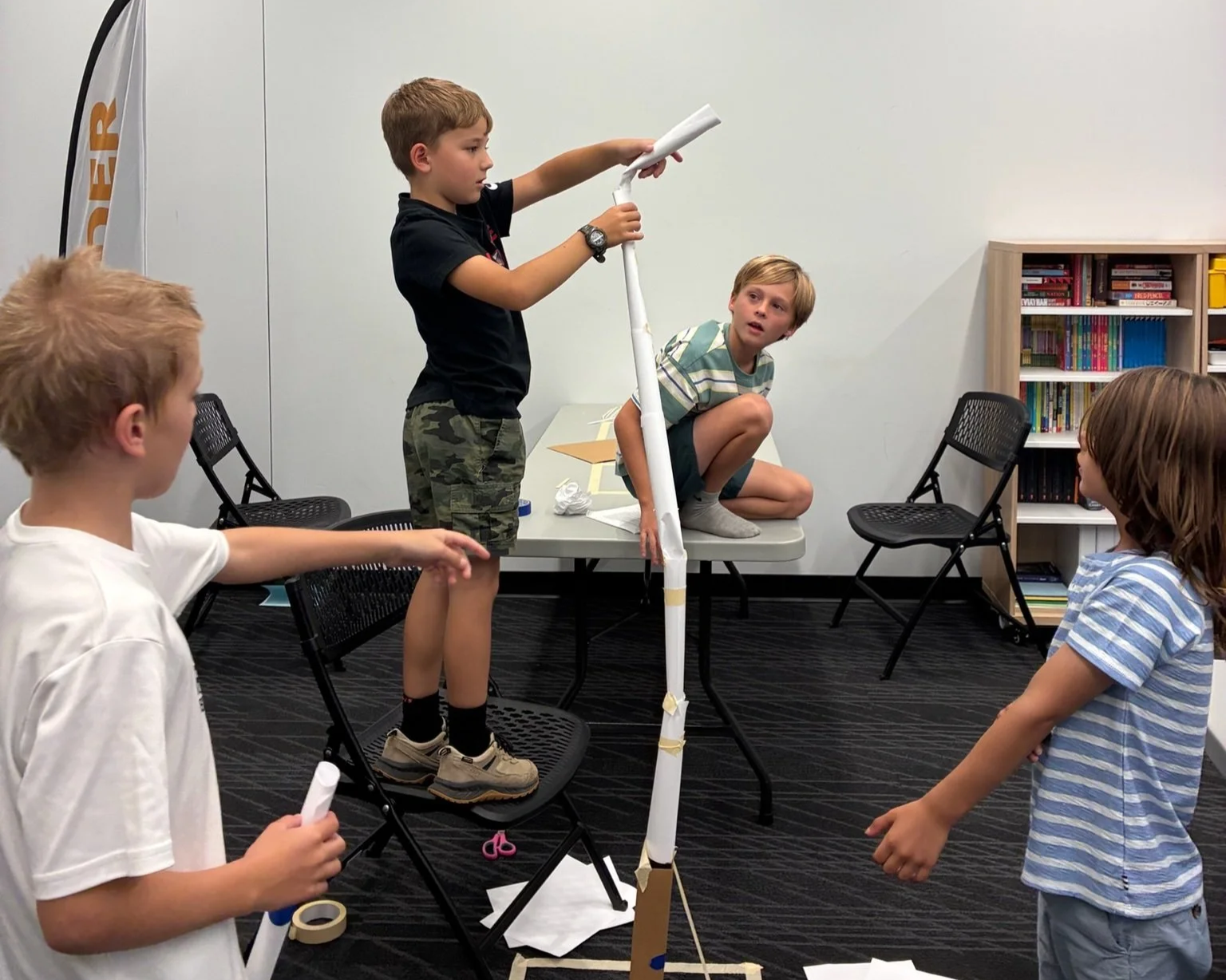
Children learn by doing the thing, getting it wrong, and adjusting. Not by being told the right answer and repeating it back. This means watching kids struggle longer than feels comfortable, which is the part adults find hardest.
7. Excellence
Freedom without standards produces mush. Acton learners hold each other to high ones. Work is reviewed by peers, revised, and revised again before it counts as done. A learner-driven school is not an easy school.
8. Freedom with Responsibility
Learners choose how to spend their time, and they live with the results. Miss a goal and you explain it to your running partner. Break a promise in the contract and your studio handles it. The freedom is real, which is exactly what makes the responsibility real.
9. Public Exhibitions of Learning
Instead of report cards, learners present their work publicly at the end of each session and take questions from a real audience. Knowing strangers will see your work changes how hard you work on it.
10. The Role of the Adult
We're guides, not teachers. Our job is to protect the environment, ask good questions, and resist the enormous temptation to jump in with answers. It's harder than lecturing, and it's the element everything else depends on.
How these fit together
Read individually, these can sound like a list of nice ideas. They work because they reinforce each other.
The Studio Contract makes freedom safe. Mixed ages make peer accountability possible. Socratic discussion makes trial and error productive instead of random. Exhibitions give excellence an audience. The Hero's Journey gives a child a reason to care about any of it.
Take one out and the rest wobble.
What this looks like at Wonder KC
Wonder is a small school by design. Our elementary and middle school studios are intentionally small, which means every learner is known, and nobody disappears into the back row.
We also hold Parent University Nights so families can experience the model themselves rather than just hearing about it. Parents sit in a Socratic discussion and find out quickly how hard it is to resist giving the answer.
Frequently asked questions
What is Acton Academy? Acton Academy is an international network of learner-driven schools founded in Austin, Texas in 2009 by Jeff and Laura Sandefer. Each campus is independently owned and operated by parents in its own community.
Is Wonder KC the same as other Acton Academies? We share the model and the ten elements. The details, our size, our schedule, our community, are ours. Every Acton is locally owned.
How is this different from Montessori? There's real overlap: mixed ages, independence, hands-on work. Acton adds Socratic discussion, public exhibitions, peer-written contracts, and a stronger focus on real-world projects as learners get older.
Come see it for yourself
Want to see how Wonder KC's guides use questions to build confident, independent learners? Schedule a visit to Wonder KC →
This post was inspired by Laura Sandefer's "How Can a Parent Keep the Spark of Curiosity Alive?" Laura is the co-founder of Acton Academy and the author of Courage to Grow. Her post also shares a list of questions from Shannon Falkenstein, founder of Acton Academy El Salvador, and it's worth reading in full.